Podcast Planner Kdp Inserts: A Practical Asset for Self-Publishing
In the competitive landscape of Amazon Kindle Direct Publishing (KDP), efficiency and quality are paramount. The process of creating a low-content or no-content book, such as a planner or journal, involves a significant investment of time in design and formatting. For publishers targeting the niche of podcast creators, a specialized interior template can be a substantial advantage. Podcast Planner Kdp Inserts represents a digital product designed to address this specific need. It is a collection of pre-formatted, editable book interiors intended for use as a podcast planner, available in multiple standard trim sizes.
Core Characteristics and Purpose
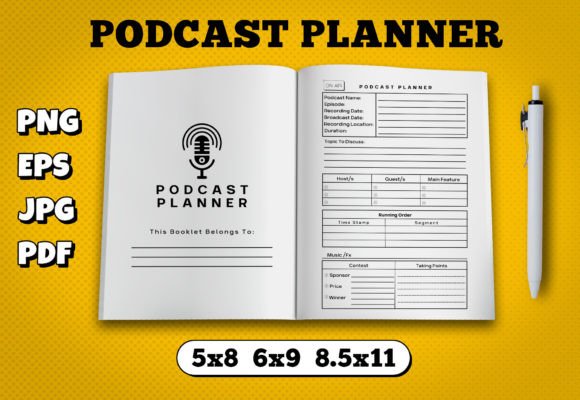
This product is fundamentally a tool for speed and consistency. It provides a complete manuscript structure for a podcast planning book, eliminating the need for a publisher to design page layouts, margins, or a coherent table of contents from scratch. The key offering is a set of digital files—JPG, PNG, EPS, and PDF formats—for three popular book dimensions: 5x8 inches, 6x9 inches, and 8.5x11 inches. These files are supplied without bleed, which is appropriate for the interior pages of a black-and-white paperback. The primary PDF file is noted as being ready for upload to the KDP platform, which suggests it meets Amazon's technical specifications for interior file submission.
The practical value lies in its role as a foundational asset. A publisher can acquire this template, potentially customize it with branding or additional pages, and have a professionally structured interior ready for publication in a fraction of the time it would take to build independently. This shifts the publisher's effort from technical design to marketing and audience building.
Evaluating Quality and Usability
From a professional standpoint, the utility of such an insert depends on several factors. The mention of multiple file formats (EPS being a vector format) indicates flexibility for minor edits in graphic design software, which is a positive for users with some design capability. The provision of a print-ready PDF ensures reliability for the core KDP upload process. The black-and-white design is a practical choice for cost-effective printing on the KDP platform.
Usability, however, extends beyond file delivery. The true test is how seamlessly the template integrates into a publisher's workflow. For an individual with no graphic design experience, the editable aspect might be limited to using the PDF as-is. The value then is purely in time savings. For a more advanced user, the other formats allow for customization, such as adding a logo or altering page orders, which enhances long-term value. The product's effectiveness is contingent on its structural design: are the page layouts logical for a podcast planner? Does it include relevant sections like episode outlines, guest trackers, recording schedules, and content calendars? The description suggests it is a "podcast planner," so these elements would be expected. A well-organized interior with thoughtful categorization would significantly outperform a generic notebook template for the target audience.
Strengths in a Real-World Context
The principal strength of Podcast Planner Kdp Inserts is its specialization. A generic planner interior requires the publisher to adapt it, whereas a podcast-specific template immediately resonates with a defined market. This can affect performance in real-world use. A podcast creator looking for a planning tool is more likely to purchase a book that clearly addresses their unique process—with sections for show notes, equipment checks, or promotion tracking—than a blank journal.
Another strength is the package's completeness regarding trim sizes. Offering three standard sizes allows a publisher to test different markets or choose the format most preferred by their audience without needing to source or create another template. This flexibility supports business scaling. Furthermore, the inclusion of the files in a ZIP folder and the statement that the manuscript can also be used for writing in or printing suggests additional applications, perhaps for physical product sales outside of KDP or for personal use, which adds to its utility.
Audience Fit and Beneficial Scenarios
This product is optimally suited for a specific segment of the KDP publisher community. It is not for authors of full-length novels or complex textbooks. The beneficiaries are likely:
- Entrepreneurial Publishers focusing on the low-content book niche who want to expand their catalog into specialized planners quickly.
- Podcast Coaches or Educators who might use this as a base to create a branded companion tool for their clients or students.
- Freelancers and Designers offering KDP publishing services to clients; this template can serve as a reliable, starting asset for client projects.
- The Podcast Creators themselves, if they wish to self-publish a planning guide based on their own methods, using the template as a foundation.
The situations where it is most beneficial are those demanding rapid deployment. For instance, a publisher noticing a trend in podcast growth might use Podcast Planner Kdp Inserts to launch a product within days to capture market interest. Similarly, a business owner creating a suite of productivity tools for creators can incorporate this specialized planner to round out their offering without diverting significant resources from other projects.
Professional Observations and Limitations
A balanced evaluation must consider possible limitations. The product description does not specify the exact number of pages or the depth of the podcast-specific content within the template. A potential buyer should seek clarity on whether it includes, for example, monthly and weekly spreads, topic brainstorming pages, or analytics trackers. The quality is inherently tied to the design sophistication of those interior pages.
Moreover, the market for podcast planner books on KDP is niche. Success depends not only on a good interior but on effective keyword targeting, cover design, and understanding the podcast community's needs. This template provides only one component—the interior. It also represents a static design; if podcast planning trends evolve, the publisher may need to update or supplement the content, which could require additional design work.
Final Practical Recommendations
Podcast Planner Kdp Inserts appears to be a practical, focused resource for a publisher aiming to serve the podcast creator audience. Its value proposition is clear: reduced time-to-market and a professionally formatted starting point. Before integration, a prospective user should assess their own technical ability to edit the provided formats if customization is needed. They should also compare the template's specific page offerings with competitor products to ensure it meets the functional expectations of podcast planners.
For those whose goals align with publishing specialized low-content books on KDP, this product can fit neatly into a workflow focused on volume and niche coverage. It allows the publisher to concentrate on the more impactful aspects of the business: marketing, audience research, and building a catalog. The additional suggestion that the shop offers more interiors like journals, organizers, and trackers indicates an opportunity for building a cohesive series of products, which can enhance brand presence and cross-selling potential. In essence, it is a tool that handles the foundational technical work, enabling the publisher to focus on strategic growth.