Evaluating the Practicality of an Editable Meal Planner Template
For many, meal planning is a conceptual ideal—a practice known to reduce stress, save money, and foster healthier eating habits. Yet, the transition from concept to consistent practice is often where the system fails. Generic notepad lists or rigid pre-printed planners frequently lack the flexibility required for dynamic weekly schedules, fluctuating household inventories, and changing dietary goals. This is where a specialized tool, like an Editable Meal Planner Template, enters the equation, not as a novelty, but as a functional document designed to bridge that gap between intention and action.
Core Functionality and Structural Design
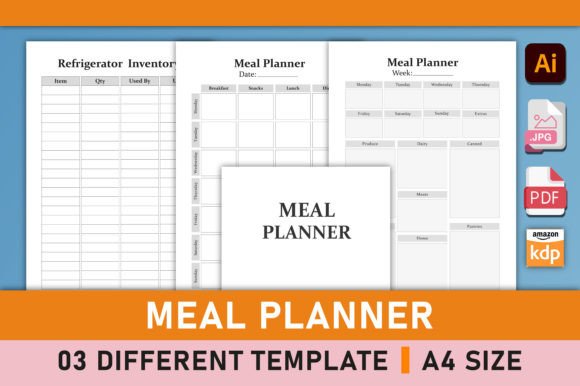
The described template package is fundamentally a digital kit. It provides three distinct A4-sized templates in an easily accessible PDF format. The core premise is editing and repetition: each card can be printed as needed, and the inclusion of editable source files allows for personalization before printing. The structural components are purpose-driven: a "Belongs to" page for ownership, a "Refrigerator Inventory" sheet to mitigate waste, a "Daily Meal Planner" for focused days, and a "Weekly Meal Planner" for overarching strategy. This separation of daily and weekly views is a critical design strength, acknowledging that some days require meticulous planning while others fit into a broader weekly framework.
From a production standpoint, the specifications—A4 trim size, CMYK color, 300 DPI resolution, no bleed—indicate it is configured for high-quality home or professional printing. The delivery as single PDF files alongside JPGs and editable sources offers multiple avenues for use, whether one prefers direct printing, digital editing, or even incorporating elements into other digital projects.
Analyzing Real-World Application and Usability
The practical value of any planner template lies in its seamless integration into an existing routine. The Editable Meal Planner Template appears to address common friction points. The refrigerator inventory, for example, directly tackles a universal issue: forgetting what is actually available, leading to duplicate purchases and spoilage. By maintaining a running inventory, users can base their meal plans on existing ingredients, which is a more economical and logical approach than planning meals from a blank slate.
The editable nature is its primary lever for flexibility. A professional with an irregular schedule might heavily utilize the daily planner for complex days and the weekly one for simpler blocks. A family managing diverse preferences could edit the template to include categories for each member before printing. The ability to print pages repeatedly turns the template into a sustainable system, not a single-use product. One could test a layout, adjust the source file, and generate a revised batch, making it an iterative tool.
Potential Strengths and Considerations for Users
The likely strengths of this resource are its adaptability and clarity. A pre-defined, beautiful but immutable planner can become obsolete if its categories don't match your cooking style. An editable template, however, can morph to focus on macro-nutrients, budget tracking, or prep-time, depending on the user's current focus. The inclusion of three different templates provides optionality, allowing users to select the layout that best resonates with their cognitive style—some prefer grids, others lists.
However, the value is contingent on the user's willingness to engage with the digital editing phase. For someone seeking a completely ready-to-print, fill-in-the-blank solution, the need to potentially open a source file in editing software could be a minor barrier. Conversely, for digitally savvy individuals or those wanting true long-term customization, this is the defining feature. The quality of the final output also depends on the user's printer, though the 300 DPI specification provides a robust foundation.
Who Stands to Benefit Most from This Template?
The audience for such a tool is broad, aligning with the described demographic of professionals, entrepreneurs, families, and hobbyists. Specifically, it suits:
- Busy Households aiming to systematize grocery shopping and meal preparation to reduce decision fatigue and ensure healthier, planned meals.
- Health-Conscious Individuals following specific dietary regimens who need a consistent log to track adherence and plan balanced meals ahead.
- Budget-Focused Users who can use the inventory and planning sheets to minimize impulsive purchases and leverage what they already own.
- Content Creators & Educators who might utilize the editable files not only for personal use but as a base asset to create derived resources for their audiences, given the commercial-ready specs.
- Freelancers & Small Business Owners with variable workloads, for whom the separate daily and weekly planners can help maintain personal nutrition during unpredictable work weeks.
The template’s design avoids being overly niche; it provides the structure for planning without imposing a specific dietary philosophy, which increases its general applicability.
Long-Term Value and Integration into a Routine
The ultimate test of a productivity tool is not initial excitement, but sustained use. The Editable Meal Planner Template is designed for this longevity through its reprintability and adaptability. As life circumstances change—a new fitness goal, a shift in household size, a tightened budget—the template can be modified to reflect new priorities. This is a significant advantage over static paper planners one might purchase annually.
For integration, a practical recommendation would be to start by using the provided PDFs as-is for a week to evaluate the layout's flow. Then, based on that experience, make targeted edits to the source file for the next print batch. This iterative approach marries the template's flexibility with real user feedback. The system encourages a cyclical process: plan, execute, review inventory, adjust the template, and plan again.
In summary, this Editable Meal Planner Template package is a utilitarian resource. Its worth is not in decorative appeal alone, but in its function as a malleable system for implementing a notoriously difficult habit. It acknowledges that effective meal planning requires both structure and personalization. For those ready to invest a small amount of time in customization, it offers a reusable framework that can evolve with their needs, potentially translating the abstract goal of "eating better" into a concrete, manageable weekly practice.